
Everything about writing is subjective. What isn't subjective are submission requirements. Frequently, a market has a word count limit. For those situations, a writer is confronted with HOW or WHAT to cut. If you don't like the word 'cut' pretend I used the word 'condense' or 'compress' ... How do you condense the material without losing essential context and diction? A call out to one of my contributors who calls it 'greening' or 'pruning' to make it less aggressive sounding. Thicken your skin - my curmudgeonly mentor phrased it - "kill your darlings". Whatever it takes to give you the right mindset for doing this during any polishing pass on your prose. For this discussion, there are two types of word count compression:
- Strategic - Story-level scene and chapter review i.e. plot point analysis/contribution
- Tactical - Prose-level tactics and strategies i.e. immersive efficiency Developmental Editing - Strategic Discussion Plot-point analysis boils down to a simple evaluation that has a LOT of abstract intangibles. For purposes of this discussion, think of your story as a long multi-day cross-country trip. At the beginning of the trip, there's a reason to go on the trip. That's the inciting event of the story. Regardless of why you're doing this long endeavor, there are stops along the way, there are unexpected pee-breaks, stops for food, gas, and lodging... the trip itself can be complicated by traffic, road hazards, and so on. So, in the analogy- think of all the incidental required "stops" along the way as contributions to the "story" of that trip. Transposing this onto your narrative, each scene is a stop. If this is just a car trip, the only REAL requirement is fuel for the car (and potentially fuel for the driver (food, sleep)). So, ancillary stops to pee, eat, take in viewpoints, and wait in traffic can be eliminated (or combined)... You can stop in one town to eat, sleep, and refuel for example (this is analogous to combining scenes). So, from the inciting event of your story, your protagonists, your world, and the story contention all should progress.
- Characters will grow and evolve - they achieve understanding in themselves and the world, and they get stronger or more resilient as individuals (achieve balance/enlightenment). The character at the beginning of the story typically cannot resolve the contention in their "beginning" state ... they must reach some new "state" in order to adequately resolve whatever issue they are facing.
- World is revealed - world-building is not just in genre fiction. In a story like Jordan Belfort's Wolf of Wallstreet the world of trading, finance, and brokers is explored and revealed. The world is where the character's stakes are developed and threatened. Rules of the world affect character growth and understanding. Aspects of the world present obstacles and shortcuts. Simply, the world shapes and challenges the protagonist. The world can't be revealed all at once, so the reader is progressively introduced to what they (and the protagonist) need to know and learn to reach the climax and resolution of the story.
- Contentions evolve - story problems CAN be static, but rarely are. If the story contention is getting back someone who has been kidnapped (alive). First, you need to know things like who and why. Then have a plan to get to the victim and so on. A typical complication would be the kidnappers move their hideout, thus forcing the protagonists to find them again now with the added tension that the kidnappers now know there's an effort to undermine the ransom plan. Regardless of the actual details of the story contention, there will be hoops and puzzles for the characters to navigate before they have all the necessary story "tokens" in order to challenge the climax / resolution of the story. So, this was a long time getting here, but plot-point analysis is looking at those three types of progression and mapping which of them is being done in a particular scene. If you look at a scene and can't figure out which progression it's advancing... YOU MAY NOT NEED IT. Everything in the story should contribute to building character, world, or plot. They are all intertwined. For the remainder of the discussion, we'll call this the 'trinity' ... every bit of your narrative should be advancing at LEAST one corner of the trinity. Long chunks of dialogue, setting details that don't add, and other non-essential fluff are candidates for cutting or revision. If something isn't getting a character closer to the resolution, or pushing them further away (i.e. some kind of complication)... doesn't mean you MUST cut, but you should optimize to make sure that word count does SOMETHING that advances one of the corners of your trinity. If you need to do a lot of compression, be brutal in this analysis. If it's a lot of words for a trivial contribution to the advancement, cut it out and add those elements into a different scene. Big picture, think of meter measuring "power" from 0 to
- At 100, we can do the story climax/resolution. How much does the scene move the needle? If you have a ten-page scene that doesn't move the needle... rethink. There's no one right answer to this ... but in the abstract ... you want everything to contribute. This includes settings that evoke or mirror character emotions that trigger change and so on. It really is a case of strategic planning. The character MUST experience X in order to understand or cope with Y. How does this help get the story to the destination? Developmental Editing - Tactical Discussion Where strategic plot-point analysis is already pretty abstract and referential, tactical editing is both more preferential and concrete at the same time. These evaluations have four general criteria:
- Cosmetic - typically done for the SOUND and FLOW - the diction. Beats. Dialect. Voice.
- Clarity - ambiguity always makes waste ... one right word can sometimes replace ten non-specific words.
- Energy - active over passive, dynamic over static, what things are versus what they aren't, showing not telling.
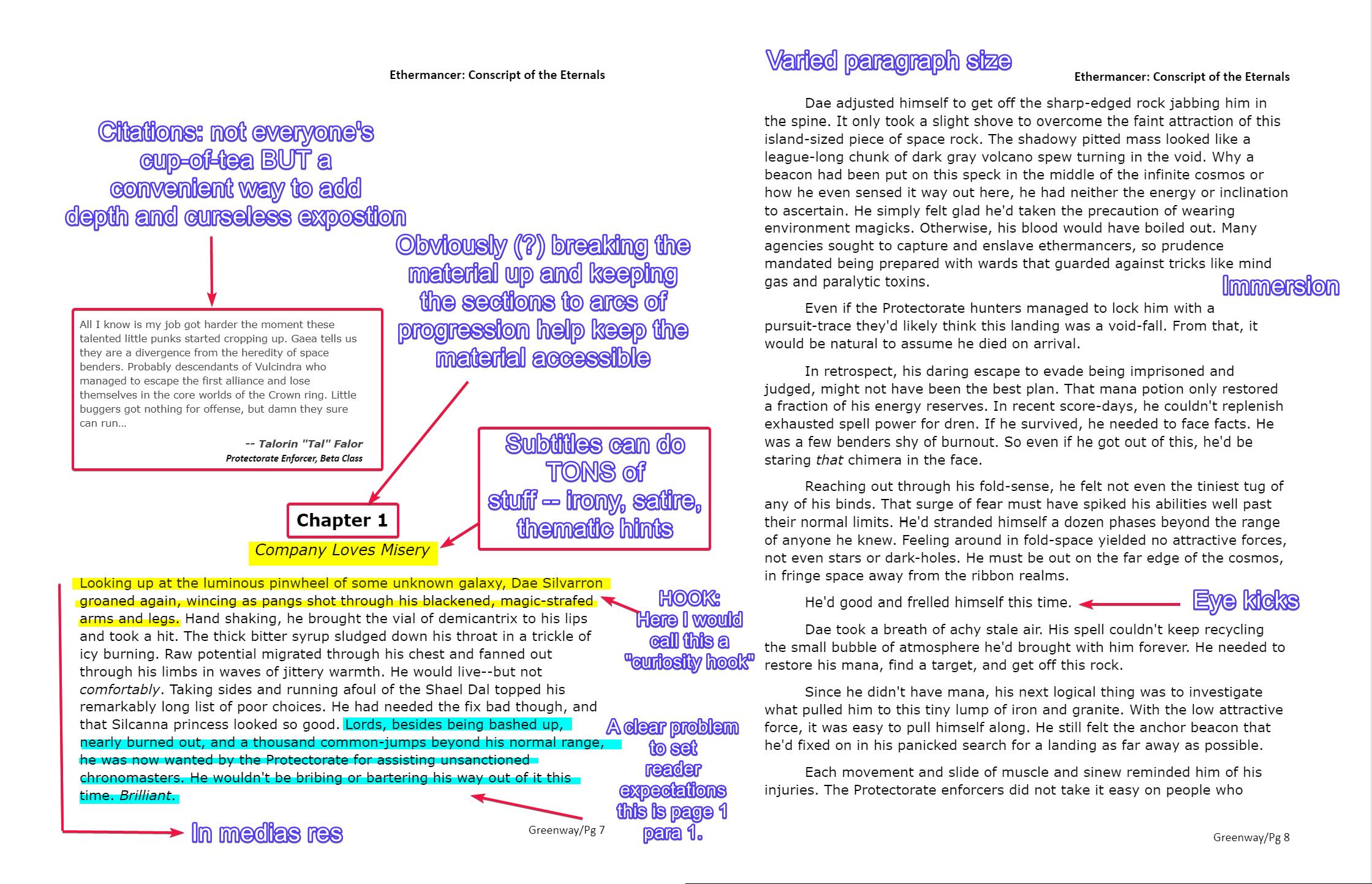
- Correctness - if a rule is broken, it should be by intention NOT accident. Correctness I will start with the last criterion first just to get it out of the way. Grammar and syntax matter- PERIOD. It annoys the crap out of an editor when it's apparent you aren't paying attention. Dumb stuff like using the wrong 'there' (i.e. they're, their, there) ... spell checkers don't catch this. Some AI grammar checkers do. Sentence fragments (I'm bad about this) and run-ons, if you're doing it... make sure you have a reason. For pacing, sometimes a fragment will seem appropriate. For emphasis, a couple of words alone on a line. Mic drop. See, made you look. Prose should be coherent and intentional- if it's INCOHERENT, it's incoherent for a REASON. Diction Here's a catch phrase: Fat is forbidden, and uniformity is boring. Fat... big long paragraphs of over a hundred words. Is it really all one long description? WARNING. WARNING. WARNING! If you see a page with no indentations... yeah, you might want to break that up into smaller chunks. Where are the sentence endings in the paragraph? I am not afraid to crack on myself. Here's an unpolished opening paragraph: There's some choices I made in there that I'll probably clear up before this goes to the publisher. The yellow line that follows the sentence terminations is a good way to visually scan for over-consistency. If a paragraph is "comma-dense" like this one... simplification may be called for. This CAN (and will) be tightened. It was written for the "sound" and not the "fury" ... so, there's places where the long sentences can be broken apart. Quick editing things... can you spot the character the paragraph is about? If it's not quickly apparent when you are reviewing something, the "owner" should be obvious from the previous context or near the front of the paragraph. Often, the stuff before the introduction of the owner is material better either eliminated, or modified so the owner is clear. The big thing about diction and self editing that not enough people practice. READ YOUR WORK ALOUD. Can you PERFORM your work? Ultimately, listen to the sound. Do you run out of breath? Do YOU feel there is a variation of emphasis and a rise and fall of the velocity of the word delivery (do the commas make the actor pause in organic speaking spots). On the subject of commas: Clarity and Energy
- Verbs are your friend, adverbs and adjectives, not so much.
- Target and destroy approximations - almost, about, nearly, over... any empty non-specific modifier that is not essential in the story context. The swing almost hit her. No, it either hit or it didn't. The sword missed, taking off a chunk of her hair. It's more words BUT I say also WHAT ACTUALLY HAPPENED.
- Eliminate passive voice when it is not painful - it's a good idea, trust me. Passive voice phrases always use the verb "to be" in some form: [be, are, is, was, been, were, being ]
- I repeat repeat - try not to tag redundant ideas and concepts together (non-essential magnification).
- Qualifying sentences - Ex: "I have a ball. The ball is large and blue." Merge -> "I have a large blue ball."
- Dialogue that simulates real life, non-essential attribution, adverbial attribution, and tortured attribution.
- * "Well, we could do this..." (The 'well,' isn't essential. Many types of pauses and interjections can be done once or twice to establish a pattern, and then dropped later to conserve on word count).
*
- If there are only two characters, the 'he/she said' can be largely eliminated after a few exchanges. Use gestures or action beats instead (it's more visual).
- * "Oh no, not again!" he complained profusely. Please tell the non-essential adverbs to expire in a fire.
*
- He stepped out of the car, tipped his hat and said, "Howdy!" Ugh. The "and said," is obvious due to the dialogue. Each paragraph of dialogue belongs to the speaker. If there's a gesture that identifies a non-sequential speaker, great, you don't need the 'said'. Now, for DICTION sake that shows the way a character takes, you MIGHT want to imbed the attribution. "However," he said. "I'd like to point out that there are exceptions." The attribution introduces a pause both visually and in performative diction.
*
- See also my dialogue posts: Great Dialogue Dialogue Formatting More On Dialogue NOT THE END - I will add more editing notes in a future revision.