
- World / story definition
*
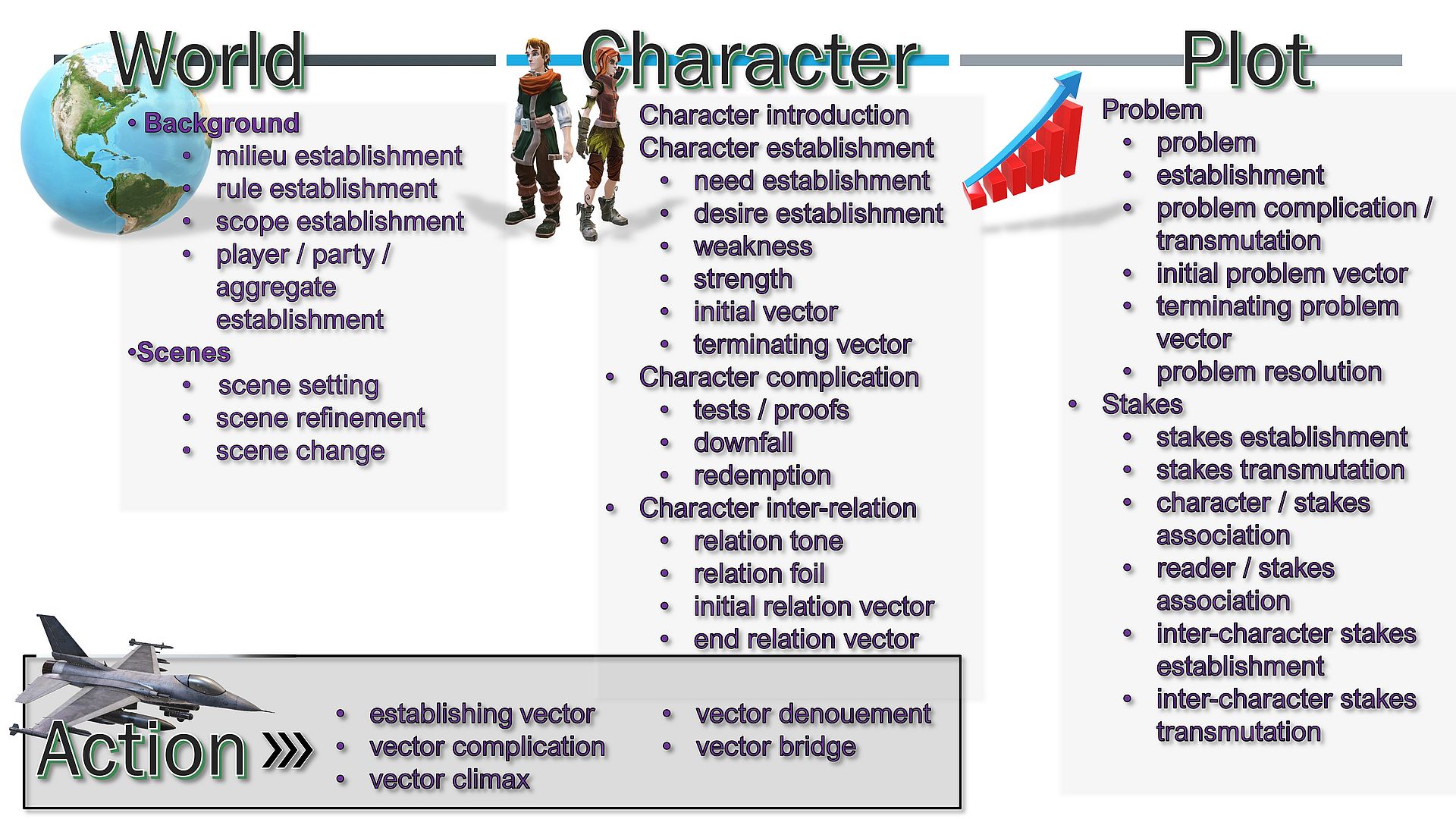
- World / Story definition is the setting within which the story takes place. It is the environment that shaped the characters and situations that will be portrayed in the narrative.
*
- Milieu establishment - The milieu establishment task is focused on fixing the story's general "place" and "time". This task also addresses the "type" of world that that the story takes place in, whether it is historical, horror, romance, modern era, fantasy, or science fiction.
*
- Rule establishment - One of the most important elements of storytelling is setting the rules. The rules are particularly important in genre fiction because they set the scope of "possibilities". For instance, if you establish that the fountain of youth exists and if you drink from it you live forever, a number of things grow out of that established "possibility". For instance, you could additionally establish that you live forever but only if you never fall in love. That restriction on the possibility is a "rule". Rules are powerful things that give direction and often provide conflict.
*
- A more contemporary example is like the hostage negotiator who has a rule never to get "personally involved". The rule is put there to be broken. It's a line drawn in the sand by the author that sets expectations.Like many of these tasks rules are a tool to enrich the story and move the plot and characters around.
*
- Scope establishment- The scope is the process of setting the reader's expectations. It sets the perimeters of where the story might go in terms of time and space.
*
- Player / party / aggregate establishment - This is the social framework of the story, and who the major players are that effect the milieu. In a contemporary story this is things like political parties, corporations, organizations, cultures and cliques that have pertinence and affect the lives and thinking of the protagonists and antagonists in the narrative.
- Scene definition
*
- Scene definition is the principle task in all writing. The main aspects of defining a scene involve the location, the scope of time that it takes place in, what characters are there and what happens in and around them.
*
- Scene setting - Setting a scene is the straightforward task of describing a location and whatever is happening there. The most effective and evocative scene descriptions are focused through a character's eyes and senses.
*
- Scene refinement - Refinement is a task of adding magnifying detail to a previously established scene. This can also be a location that changes or evolves over time. This is otherwise the same as an initial setting description.
*
- Scene change - A scene change is a transition into or out of a particular place and time. A transition IN is usually called an introduction while a transition out is called a bridge. The nuances of scene changes vary depending on where they lay in relation to the sectioning of the story. For instance, the introduction at the beginning of a chapter, and especially at the beginning of a novel is a little heavier and the execution more critical. This is different from an interior scene change that may be as simple as a space break. Scene bridges are a lesser used nicety that are none-the-less effective when well written. A common example of a good bridging technique is the cliff-hanger. The cliff-hanger ends on a shock moment where a character is in danger or a surprise character is introduced. The goal of this is to pique the reader's interest so that they will continue reading in the next chapter.
- Character (Protagonists / Antagonists) definition
*
- The general task of character definition is fairly self explanatory. The goal of any character development is for the reader to know that person well enough that they themselves can predict (or think they can) what that person will do and how they will react in the situations you depict.
*
- Character introduction - This is the task of describing a character's initial entry into the story. The first time they are observed by the reader. Hopefully this first meeting will be memorable and provide important tags and details that will make that person stand out in some way (if that's what you want).
*
- Character establishment - Where the introduction is the character at first-glance, establishment begins to probe into what makes that person unique. This is where special ticks and traits are revealed that weren't apparent during the first encounter.
*
- Desire establishment-A character's desire is what they are striving to accomplish. However a characters wants and needs CAN be the same. It just tends to be more dramatically convenient if they are different. What a character desires usually says a lot about them. Like the need line, sometimes what the character desires is opposed by either the antagonist's wants or needs.
*
- Need establishment - A character's secret "need" is a function of plot that describes the arc of change that the character goes through during the course of the story. The "need" is what a character must accomplish in order to be fulfilled. Often what an antagonist needs is directly opposed to what the protagonist desires. Showing the needs of secondary characters is not essential but it is one of those things that brings characters to life. Often the "need line" opposes a character's "desire line", and it is the opposition of what a character wants to do versus what they must do that provides dramatic and emotional tension.
*
- Weakness-This is a depiction of the character's Achilles heel. Sometimes it can be a simple as Harrison Ford's line in Indianna Jones, "Snakes. Why did it have to be snakes?"
*
- The weakness is often used to foreshadow what will become that character's greatest challenge in the story.
*
- Strength - This is the counterpoint to the character's weakness. The strength is sometimes a virtue shown in an antagonist character to demonstrate that they are not completely irredeemably black.
*
- In any case, the strength is something telling where a personality in the story excels.
*
- Initial vector- Vector in narrative are the relative direction a character is going in relation to the path of solving the problem and its related nuances. There are three kinds of character vectors: action vectors (what they do), intellectual vectors (what they believe), and spiritual vectors (what they feel) all of which may or may not be traced through the course of the narrative.
*
- As described earlier in the article, a vector can be downstream (helping) or upstream (hindering) the story resolution. A character can have multiple vectors, especially in regards to other characters (which will be discussed below). A character can obviously start out helping and later through the course of events change direction.
*
- Terminating vector - This is the flip side of the initial vector. The terminating vector is where the character ends up after a scene or section. Terminating vectors tend to apply more to intellectual / spiritual registers as events in the story affect the thinking and feeling of the protagonists and antagonists.
*
- Character complication - Complication is an extension of character establishment. At this point we are deep into psychology of a protagonist or antagonist and digging at the core elements of who they are.
*
- Tests / proofs - Tests and proofs are events and happenings which evoke specific responses from a character that show a core trait. An example is a character who breaks into tears whenever they hear a particular song because it reminds them of something sad.
*
- Downfall-The downfall is related to a character's weakness. However, it can simply be when a character just caves in the face of the story problem.
It can also be when they simply make a critical error that profoundly effects the solving of the story problem. *
- Redemption-Where the downfall depicts the all-is-lost scenario as brought on by some calamitous happening, redemption is the hair-brained plan or the one-in-a-million chance that will allow the character to overcome.
*
- Character inter-relation - Inter-relation tasks are simply those that depict the juxtaposition of different characters, how they start out feeling about one another and how they ultimately end up. Many are the stories where the hero and heroine simply can't stand each other but end up being in love at the end.
*
- Relation tone-The relation tone is the OUTWARD expression of how a character feels about other characters in the story. How a character really feels may be a mystery even to the character themselves.
*
- Relation foil - The foil is a character that brings out specific responses from another, typically these responses are "out of character" or revealing in some manner. The vivacious woman who can make the hard-eyed hard-talking detective stumble and falter. It can also be the innocent kid asking stupid questions of the war-weary veteren who sees himself as a youth. The concept of the foil is time honored for a reason-it works.
*
- Initial relation vector - The initial relation vector is similar to the character's main vector only it concerns only how that character relates to another person in the story. For instance, two men are friends but things are happening to make it appear that they are moving toward becoming enemies. So, this vector is primarily an emotional/psychological path.
*
- Terminating relation vector - The terminating vector is where the two characters finally end up. They may move to where they seem to hate one another, then at the end overcome the feelings creating the rift between them.
- Plot definition
*
- The task of defining the plot is one of those seemingly easy jobs that must be structured and considered more carefully than people realize. Often a writer throws out a problem without fully considering how he/she will engage the protagonist(s) to solve it. For instance, just because the world is threatened does NOT mean the hero will feel driven to risk his/her life to resolve the crisis. However, if the hero's love is strapped to the bomb that will blow up the world- now, it's a wee bit more personal. This is the concept of stakes. The stakes tie the protagonist to problem in some way to get them to engage it.
- Problem - It is rare that a story of any length has only ONE problem. Many times the character is dealing with multiple issues related to the problem as well as side difficulties. These side considerations are called sub-plots that have their own stakes and resolution.
- *
- Problem establishment - This is where the problem (or some hint of it) is first shown to the reader (and potentially the protagonist as well).
- *
- Problem complication / transmutation - Four words: things just got worse. This is when the problem scope grows or changes from what the protagonists thought it was.
- *
- Initial problem vector - Where characters have a vector toward solving a problem. Problems often (not always) have a vector toward a particular goal. The "vector" itself can be an assumption the protagonists make about the problem. For instance, the hero thinking the villain wants to rob a bank, when really it's to kill someone in the bank, or accomplish something larger.
- *
- Terminating problem vector-This is when the actual goal or the true nature of the problem is revealed.
- *
- Problem resolution - Simple as that, the thing that the hero(ine) has gone through heck to achieve is finally realized. Sometimes this is a last instant twist of fate, or a carefully executed plan, or simple grit and determination. Don't forget sub-plots need resolution too...
- Stakes
- *
- As detailed in the section under plot, the stakes are an extremely important aspect of plot as they tie the protagonists to the story. The person who has nothing at risk can (and probably will) walk away when the going gets tough. Sometimes, the protagonist LOSES what's at stake, and that loss is a powerful motivator. Revenge anybody? At any rate, problems without stakes tend to be two dimensional.
- *
- Stakes establishment - This is where the reader learns of the details that may later motivate the protagonists to solve the problem. For instance, a character is introduced whom the protagonist falls madly in love with. Later, the villain kidnaps this person. Now, the villain who we may have only been mildly engaged in finding has made it personal. This steps up the tension.
- *
- So, the stakes do not have to be immediately tied to the problem. It just has to be demonstrated as something that the character cares about. It can be a person, a thing, a cause, even an idea... as long as the protagonist has some emotional/intellectual attachment to it. I
- *
- In stories with multiple protagonists, they may each have different things at stake (or the same thing) and different reasons that those stakes motivate them. It's important to keep all those balls in the air as you move toward the plot resolution.
- *
- Remember, a character can have MULTIPLE things at stake as discussed in the next section.
- *
- Stakes transmutation - This is when what's at stake is different than what the protagonist originally thought. A simple example, the hero has a wife and a daughter, he thinks the threat is to his wife and finds out it's his daughter instead.
- *
- The transmutation can be that the scope of what's at stake grows or changes in some way. For instance, the problem isn't just a threat to his family but to a whole city.
- *
- Character / stakes association - This is where what ties the protagonist to what's at stake is refined and expanded upon. The growing love between the hero and heroine who will be put at risk.
- *
- Reader / stakes association- This is a key but tricky task. You as the writer should try to make what's at stake not only important to the protagonist but to the reader as well. This can be done in a number of ways. A lot of times it is simply a lovable or humorous character who you make extra effort to make sure the reader grows attached to them. The reader's involvement with the stakes can be something less concrete, it can be a "beautiful love" that will be ruined by the a falling out caused by the story problem. Again, this is an important relationship to build and some pains and thought should go into scene bits that move toward this goal.
- *
- Inter-character stakes establishment - This is when you spend scene time to clarify stakes shared by protagonists (or antagonists)- or sometimes by a protagonist and an antagonist. For example, the hero and the villain both love the same person. Success for the villain means the hero loses their love, success for the hero means the villain loses THEIR love. These kinds of stakes occur frequently when what's at risk is a cause or an organization or something where multiple people have invested effort, time and resources.
- *
- Inter-character stakes transmutation - This is similar to the standard stakes transmutation only now the focus is on how the change of the shared stakes affects the various people with vested interest in it.
- *
- An example of this is two characters love a third (standard love triangle) only to find out there was a third rival unknown to both them (a love polyhedron!).
- Action
*
- The action task category is a special instance in the task list because it is not really a structural element in writing. It however is a key portion of energetic stories where there's significant conflict.
That's not to say that more sedate stories might not use action tasks, they are simply less likely to. *
- Action tasks tend to go hand in hand with characterizing or plot establishment tasks and are like side goals. What a character says and thinks characterizes them. However, in some instances what a character does, and how they do it is the way they are defined. As an example use a couple of Clint Eastwood roles. As Dirty Harry, a lot of what he SAYS characterizes him. "I know what you're thinking. 'Did he fire six shots or only five?' Well, to tell you the truth, in all this excitement I kind of lost track myself. But being as this is a .44 Magnum, the most powerful handgun in the world, and would blow your head clean off, you've got to ask yourself a question: Do I feel lucky? Well, do ya, punk?" Contrast this type of characterizing (which truthfully involved a lot of action too) with Clint's role in High Plains Drifter where the character really only has a few lines and is defined primarily by his actions. He speaks with his gun you might say.
*
- So, the goal of action tasks is to enhance and bring out signature traits and emotions in the characters of the story. A lot of the work in these tasks is in establishing the situations and the conditions under which the activity will take place.
*
- Take as an example a scene in any of hundreds of martial arts movies where the hero is walking by and the poor helpless slob is being picked on by bullies who just happen to be martial artists. You just KNOW the hero HAS to defend the weak (it's a rule right?). So, the hero leaps in to defend the victim first by just talking it over. The hero is a peace-loving guy after all, no sense in shedding blood if it's not necessary. Well, of course things just HAVE to escalate and the hero is forced to kick some villain tails.
*
- In terms of the story, this conflict may have NOTHING to do with the main problem. It's just action used to demonstrate things about the hero. It shows he's a decent person willing to help out another in need. It shows that he doesn't immediately start shedding blood when talking has even a slim chance of averting disaster. The fight itself often portrays signature aspects of the character. Anyone who's seen a Jackie Chan fight scene with all the acrobatic antics done for humor sake will understand how a fighting style can characterize. Even how the fight ENDS serves to characterize, as usually the dumb hero is merciful and lets the bullies go. I stress dumb, because don't they always come back to threaten a vulnerable girlfriend or something else dear to the hero?
*
- Establishing vector - For purposes of action tasks, there will be some kind of problem in the scene. So as not to confuse the action task's conflict with the main story conflict (problem) we'll call this difficulty a "catalyst". Most establishing vectors involve a situation where something the hero cares about is put at risk. This is not always the case because as talked about in the example above, it can simply be a matter of conscience or honor.
*
- I should note that the catalyst in an action vector CAN be something related to the main problem. I just wanted to stress that they don't have to be. I sometimes add action tasks simply to make a flat scene more exciting.
*
- The vector that a character takes is what choices they make in response to the catalyst. In my trite martial arts example, the hero sees the bullies picking on the helpless guy and decides to intervene. That's the vector, he's committed to breaking up the fight and saving the guy from getting beat down.
*
- Vector complication - A complication is when the character is forced to change the course of the action they've chosen due to some new element in the situation. Going back to the bad martial arts movie example, this is when the generally weak gang has one tough guy in it. What starts as a routine slap around of a few throw-away villain extras becomes a whole new situation as the hero is suddenly faced with an enemy who poses a real threat.
*
- This kind of complication in an action scene is fairly common. You've seen this in cartoons where the hunter is chasing somebody only to have them pop up with an even bigger gun aimed at them. Then the hunter will pull out and even larger weapon which is countered again and so on. This see-sawing of the balance of power can happen at different levels depending on how protracted the action is. You rarely want a fight to go all one way. You need your protagonists to feel challenged at some point so they need to take some lumps and make some missteps.
*
- Vector climax -The climax is where the reaction to the catalyst reaches its peak. The hero is starting to lose against the gang tough, his shirt is torn, his face is bloody. The exhausted hero rips off his shirt baring his sweaty torso, clenches his fists and now it's time to get serious. Through grit and the removal of a ripped shirt, he suddenly has the power to overcome the tough.
*
- Vector denouement - The denouement is the wrap up after the climax. The hero has won. A lot of times the hero is presented with a grateful person who promises to do them a favor in the future (which they usually do) or they provide a tidbit of information that helps the hero in their quest to solve the main story problem. I know the examples I'm giving are trite but they are fairly universal standards you see in various stories and movies.
*
- Though I make light of it the denouement, using it to tie the action to main plot problem is a valid and useful technique. It's value is especially marked for throw away action sequences that are there mostly to showcase a protagonist or villain in the story.
*
- Vector bridge - The bridge is what connects the end of the action sequence into the scenes that follow after. As described in the bit on denouement often the hero is rewarded for their good deed and gets a clue that moves the plot forward. It is in the bridge that the clue is revealed to be part of the larger plot. The hero then rushes of to the next stage (scene) in the story.