 |
Beginning Writer's CraftTicks, Quirks, and Flaws: Point of View and the Essence of Character© Will Greenway 2000 |
 |
People. If there is anything a writer should never forget, it is that stories are about people.
Not only are they about people, they are even more importantly—for people. Make no mistake,
whether your protagonist is a blue cetacean from alpha centauri, an anthropomorphic
hip-hoppin rabbit, or
a fifteenth century lady-in-waiting they all have personality—they must be humanized in or
for your reader to relate to and like them.
This isn't a suggestion to make up a laundry list of traits for a character, but they are some recommended things to consider when getting know your characters. In truth, a bunch of details won't make your people come off the page. However, knowing them well enough that you can answer those questions without thinking is a way of becoming familiar enough with them so that their character can come through on paper.
In trying to capture the sense of a person (or alien, or creature), it is
essential to know what characterizes. When thinking about character, fiction writers can take a page
from journalistic writing, to get a handle on the personalities in their stories. Consider the following
questions:
| The Five 'W's of Personality |
|
|---|
This isn't a suggestion to make up a laundry list of traits for a character, but they are some recommended things to consider when getting know your characters. In truth, a bunch of details won't make your people come off the page. However, knowing them well enough that you can answer those questions without thinking is a way of becoming familiar enough with them so that their character can come through on paper.
Coming Alive
The best bits that make a character sparkle are many and varied. However, it usually comes down to a memorable line that simply captures the essence of who that person is. There is no set formula for this. It's often a moment unintended by the writer that ends up being oh-so-appropriate. It comes from knowing the characters of your story well enough that there is no forcing. Characters that really come across are ones that you are comfortable with. There is no doubt or wavering, you know what that person will do or say in a given situation without giving it much thought.
This is where roleplaying and reading your material aloud really begin to make a difference in your writing. If you have never read your material aloud—or better yet, had someone else read it to you—you've never really heard your characters speak. There is no better tool for fine tuning your prose than to listen to rhythms of the words, and more importantly, how your characters speak and act.
A critical consideration here, is whether you hear your characters at all. Is it all exposition with a couple of lines of dialogue? Could be a problem. An engaging narrative is a balance of internalization AND externalization (dialogue and interaction). The best characterization tends to be a balance of both as well. Knowing how someone thinks is only part of the puzzle. How they act, and what reactions they exhibit (as opposed to how they feel) give depth and realism to a personality.
In the broadest sense, every character is an archetype painted in broad strokes. Example: She was the type of girl who cried at weddings and funerals, loved puppies and children, and would have died before violating her oath of service. This is only one sentence, but in it we get a broad sense of this person. Notice also, that there are also details about the person—things she likes and a tidbit here of what this person does. I cannot stress this too much, a LOT of characterization can be done with a few well thought out lines. Believe it or not, characterization is NOT knowing every last detail about a character. It's specific details and telling nuances that create a memorable image. This is where you the writer must trust the reader and allow them to have some involvement the creative process. Pin down some hard and fast constants in a character, hint or suggest at other things and let the reader fill in those gaps. Just don't make those gaps too big—again it's balance. Enough detail to quench the thirst, but several drinks shy of a buzz.
If this all sounds like hedging; it is. There are so many ways to realize a character that it's extremely tough to outline specific methods for doing it. Much of the way characterization is handled relates to a writer's style and voice, which are the ways you decide to present the story. The narrative voice (the expositive presence in the story) has its own distinct character. For MANY, the narrator IS the writer. In beginning work, and too often for my taste, in commercial pieces, that narrator can have a stronger presence than the protagonists of the story. The narrator is omnipresent and all-knowing, and sometimes JUST CAN'T RESIST telling the future of our heroes. These writers simply don't realize that by telling us how it turns out a hundred pages before it happens blunts our curiosity and drains tension from the work. Narrative presence and story texture are good things, but not at the expense of the plot and characters in your story.
Characters are extensions of the world, it's reality, and a bleed-through of a writer's own personality. No matter what you do, your characters will have aspects and elements of yourself in them. You can't help it. You are a product of your upbringing. Your values, ethics, morals and personal quirks will all worm their way into your fictional people (if you let them). The more you try to make them un-like yourself, the more they become a distorted reflection of you. If there's anything to take away from this, it's that you might as well be honest with yourself because your characters will tell the truth on you eventually. Don't be afraid of it—embrace it.
The Cult of Personality
Okay, enough philosophy about personality and characterization, lets identify some types of personalizing narrative and also give some concrete techniques and examples. As much as possible look for some of the twists that I add to the examples. As mentioned before, characterization often comes down to nuance. I've tried in the descriptions and examples to add some of those touches that lift a bit of description to that 'next level'.
NAME — I don't think I have to go much into this. The name is where most readers start to know a character. It is also where many writers lose copious amounts of sleep and hair. Names don't always give the essence of a character, but it really works when they do. Sometimes a name tells a story in itself—as it did in Johnny Carson's song A Boy Named Sue. A word of advice, don't get too hung up on a name... I know many who change the names of their characters four and five times during the course of writing their novel. Thank heavens for word processors and search and replace!
PHYSICAL DESCRIPTION — This can be handled a number of ways in narrative. The classic example of this is the character looking in a mirror or other reflective surface and reacting to their own appearance. It's sooo common, BUT it is the one that allows the writer to describe the point-of-view character without resorting to some narrative viewpoint shift. Some other examples of direct narrative characterization / description are listed below:
|
Take note that a physical description is best if it somehow suggests personality. I doubt anyone can read the description of Hugh in the last example and not draw some conclusions about his character and what he does for a living. However, it can sometimes be more subtle like Rita's 'I-dare-you blue' eyes. Always try to make things like a description do double duty if possible. This is 'packing' or 'loading' your sentences. Balance this against what is simple and straightforward. Be mindful of the tone of the scene. If the passage occurs where action is going on, it will be more terse. In a slower more relaxed setting, you have more room to elaborate.
INTERNALIZATION — This is the internal dialogue (thoughts) of the viewpoint character. In some cases, you will see writers who give thoughts and emotions of characters who are not the viewpoint character. In my opinion, this is bad writing etiquette. However, I see way too much of it being done by established *cough* authors to completely discount the mechanism. I find such shifts in viewpoint are both unnecessary and jarring—not to mention lazy. If you're going to 'head-hop' anyway, be aware there are some editors who frown on it as much as I do. Try to make it as unobtrusive as possible. I must add, that from a structure and tension standpoint that knowing what everybody is thinking can create problems. Don't say you weren't warned. Did I mention I don't like 'head-hopping'?
Remember that there are two aspects of internalization. One part is the characters reactions and interactions with the world. The other part is the CONTEXT that is the basis for those reactions. An example of this is a character who is claustrophobic. That's a personality trait that can be brought out in a number of ways. The CONTEXT could be that this character was locked in closet for days at time as child and that's WHY they're afraid of closed in places. To put it simply, knowing the context is often far more important than the trait itself. Traits often exist as hooks to introduce such character defining information. Another example of this is something like a scar (which would be a physical trait). If you give the scar, it's very effective if tied to some personality defining experience.
The last aspect I'll touch on about internalization is how it's given to the reader. It can be done in character, or it can be done in an expositive fashion. Obviously, in-character is the better of the two, however, it tends to be the least often done.
Aspects and types of internalization:
|
Internal monologue is your reader's view into the mind of the viewpoint characters. It is the mechanism through which we learnyour character's feelings and can get a handle on their goals, desires, and failings. As I have discussed in other segments of the craft articles, remember that stories are best shown—not told. Don't overdo the internal narrative. Remember that much can be said with a little. You can tell us the character is angry, or you can simply describe their face being hot, their clenched fists and pounding heart. You are doing the same thing, only being more visual and sensual in your depiction.
It's All About Attitude
DIALOGUE — What your characters say, and how they say it is probably the most powerful characterizing force in writing. While we're discussing dialogue, never forget body language. The raise of an eyebrow, the clench of fist or twitch of an eye... these things are characters talking too—in a visual and expressive shorthand. These are all part of a character's stage presence in the story.
Earlier I mentioned reading aloud was suggested. It is almost essential for dialogue if you don't already have an ear for it. Speech patterns, how people speak, their voice and the context of their words all define the person talking.
Unfortunately, there's no magic formula for good dialogue, except that too much of good thing can dilute it. Mostly, it comes down to the blending of aspects. Imagine that slit-eyed Dirty Harry scowl while he aims the forty-four magnum (the world's most powerful handgun that 'could blow man's head clean off' he tells us), and that growling Clint Eastwood voice rumbling out, "So, do ya feel lucky, Punk? Well, do ya?" It doesn't have the impact without the gun, the squint, and that rough tone. It's all part of a persona that is all of a character's visual traits and habits being expressed together.
Your characters need a stage presence, a definite attitude that makes them visual and memorable BEFORE we have an opportunity to get in their heads. This is where really doing your homework and thinking visually about your people will benefit your story.
One helpful thing to do is to cast movie stars in the roles of your characters. Who would fit? How would they deliver the language and what would it sound like? Keep that image in mind when you sit down to write a scene where you're establishing a character's personality.
Again, let me stress, that dialogue is more than the words between the double quotes. To characterize, you must also consider gestures, expressions, and internalizations that set beats and balances in the perception the reader gets of the fictional person.
It's important to consider also how characters will interact. Some characters won't reveal their nature without another to interact with. In some cases, only the right someone. It's up to you to cast the story so that some of these aspects will be revealed. Some characters only exist to be foils for the main character in a novel or story.
In the scene that follows, a new character is introduced. It is also this particular juncture we learning some things about the life philosophy of the viewpoint character Wren who was born on the streets, but is now in the company of nobility. This example provides opportunity to look at lot of characterizing aspects—gestures, expressions, and internalizations.
|
|
|
Wren covered her face with her hands. "Oh please!" She rocked her head back. "No one gives a dragon flop about what I condone or not. You can't eat an ethic, and morals—well, morals aren't very filling either."
"You're eating now, aren't you?"
"Don't think I don't appreciate it either." She knuckled her eyes. "I also know it's costing me."
"You're very cynical for someone your age," a young woman said walking in from the hall.
At first glance, she looked younger than Eviria, but the way she moved, the sway of her broad hips, and the thrust of her bosom against the brilliant red surcoat suggested a far more mature woman. Auburn hair pulled into a back bun then wrapped tightly to form a tail gave her an exotic look. The similarity in appearance to Eviria made them at least sisters. Carrying a jeweled and metal shod staff taller than herself, and sporting a sword on her hip, she cut an attention getting profile.
The woman stopped between Darin'Kel and Eviria,
put aside her staff, and hooked an arm around each of their necks.
Wren didn't say anything, just looked at the woman. She learned the hard way with Gabriella and wasn't about to make the same mistake twice.
"You must be Wren," the woman said.
"You have the advantage," Wren responded.
The woman raised a finger. "Oh, so I do. We've spoken, although you might not remember. My name is Dorian."
"You mean with the mindspeak," Wren asked.
"That was I," Dorian confirmed.
"I don't know—I pictured you as—"
"Older, yes, I know. So, have my children been taking care of you?"
"Children?" Wren was lost. Dorian
looked like a child herself.
"These two," Dorian pulled on Darin, then Eviria. The resemblance
was extremely strong.
"I thought Desiray..."
"She is."
Wren sighed. "Nevermind, I don't want to know."
Dorian grinned. "A perfectly acceptable attitude. Sometimes,
I don't want to know."
"Mother," Eviria growled.
The mage kissed the girl on the ear, then focused intense green eyes on Wren. "It sounded like I came in on the tail of an ethical dilemma."
Wren shrugged. "For them maybe. They're trying to convince me how I owe society, and how I couldn't possibly allow myself to work for dishonest, violence mongering folk."
Dorian raised an eyebrow and smiled. The woman's smile was unsettling, as if she knew something she shouldn't. "I can understand how you might feel even somewhat justified. Forced to fend for yourself, chased around—abused. I could see how anyone would be rightfully angry about how that was allowed to happen to you."
The way she said it, the tone of her voice, the look on her face, Wren was certain the woman understood exactly how she felt as if she'd been there herself.
"Uh huh," Wren confirmed.
"You owe them nothing," Dorian went on.
Wren nodded. "Yes."
"If anything—society owes you, and everyone else who had to suffer the same way, right?"
"Precisely."
"And of course, you wouldn't feel a bit of remorse over helping those same people to disadvantage others like yourself. After all, you paid your dues, it's time to get on the payroll and collect!"
"Yeah—!" Wren stopped. "I mean—no."
Dorian looked at her sideways. "What? Can't have it both ways, Dear."
Wren closed her eyes. Like a green fresh into training, she'd followed the bait right to the hook. What an idiot she was. She felt her face flush. Bloody mages, always twisting words around. "Dammit, I was starting to like you..."
|
If you pull this example apart you can find a lot of different writing techniques at work. Notice that the characters interact, not only in dialogue, but in physical contact as well. Characters sigh, grin, and give facial expressions. Internal thoughts are interspersed, Wren's speculations and reactions to the things being said. Note also the use of the MDASH (—) which is used to simulate pauses and breaks in speech. This adds color, rhythm, and impact to dialogue when used effectively.
Key to what we have here is characters displaying attitude. Notice in this scene, Dorian and Wren at first seem to agree, but really don't. This mini-scene sets up and shows the way that Dorian twists words. It is this kind of deception that will later be this character's central defining attribute—everybody respects Dorian, but nobody trusts her.
There is another element at work in scenes like this, and that is chemistry. Dorian is a extremely educated woman with a perchance for teasing and deception, and Wren is head-strong independent young woman raised in the streets who takes herself pretty seriously. These two are so different that when set at tangents to one another, there's bound to be sparks. This is an aspect of planning the scenes you choose to write. Dorian could have merely disagreed with Wren, but instead verbally tricks her. Both Dorian's choice, and Wren's reaction "Dammit, I was starting to like you..." work to characterize both of them. The chemistry, the attitude that each brings out in each other is a dynamic that makes scenes both more interesting and entertaining.
The next example shows a more extreme character, more stylized with even more attitude. Master Falor is introduced in this scene, where he will test the protagonist Corim to see if he is worthy to be a teacher in the sword-fighting school. Here, we have action interspersed with characterization. We have many of the same elements of the first example, only now it is done in an action scene.
|
|
|
The scalewood door on the far side of the chamber unbolted and swung open. A
dark-haired man dressed in a vest and leggings strode in with a large duffle
over one shoulder.
"We ready to go?" he boomed.
The swarthy Master Falor was a head taller than Corim and built as though he
lifted horses for a living. A tear-drop shaped sapphire dangled from a
platinum braid around the man's corded neck. If any fat existed on the man's
frame, Corim couldn't see it.
He dropped the duffle next to Corim's. It hit with a thud that made the floor
shake.
"So you're the new kid, eh?" He held out a thick hand.
Corim looked at Falor's extended arm. After a moment he realized Tal expected
him to clasp hands. An odd custom, wonder where it comes from. The
master shook his hand, the naked force radiating from him electrified the air.
His grip was just hard enough to be painful. Corim met his dark eyes,
responding with a firm pressure of his own.
"Call me Tal. I don't cater to the master crap. I like things informal.
Just mind the chain of command, and there won't be any problems."
This is a man who is rarely told 'no'. "Yes, Sir."
Tal looked at Ceraph. "So, you gonna be the kid's corner girl?"
The elf's brow furrowed. "What—?"
"Never mind." Tal pulled a massive sword from the duffle and set it
down with a clank. Dumping out a heavy dueling glove, a thick leather
back-belt and shoulder harness, he put them on.
He looked over at Corim's equipment and whistled. Picking up Corim's sword,
Tal examined it. "Shakiran Warwand isn't it? A month's tournament
winnings if it's a copper."
Corim nodded. "Worth it, too."
"Nice balance, strong, good flex." He returned it. "Hate to say
it, Kid, but it's only a fancy gadget. You'll break five before I replace this
one." He hefted his own weapon that looked as thick and wide as a man's
hand.
"What is it? An anvil pounded into the shape of a sword?"
Tal chuckled. "Only half an anvil. Suit up, and let's get to it."
Eying the Master's huge weapon, Corim let Ceraph help him don his carapace and
grieves. He picked up his heavy mask and looked at Tal who hadn't moved to put
on any protective armor.
"Aren't you going to wear anything?"
Tal raised an eyebrow. "You think you're going to hit me?"
Corim paused. "That is the idea."
"Kid, if you can cut me with that toy. I'll give you the school."
Corim studied Tal, trying to determine if he was serious.
He might not be
the best fighter on Titaan, but he wasn't that feeble.
He's the master. He put the mask on and tightened the strap. Scars on
his body he could handle, but not his face. He stayed wide of Tal, shifting
toward the center, all the while keeping an eye on the big man.
Tal rolled his shoulders, and moved his head side-to-side to limber up his
neck. He spun the heavy sword as if it were made of wood.
Ishtar, he's strong.
"Come on, Kid, I'm not here to play
games." He tossed the sword to his
left hand and whirled it with equal dexterity as the right.
He's a switch fighter, too. This keeps getting harder. Corim focused,
feeling the rush of power as he willed himself into battlemind.
Tal stood flat-footed at the center of the ring, moving the sword from hand to
hand. Corim struck between exchanges, driving in to knock the huge weapon out
of reach.
Corim hit nothing as Tal spun clear. He dived and heard steel hiss over his
back. Corim hit the dirt rolling and reversed his direction with a kickoff.
Another blow smashed the turf, missing him by a hair. He handsprung to his
feet in time to block.
The weapons impacted with a burst of metallic thunder. Corim felt the blow
through every bone. He leaped over a shot, ducked another, and evaded a lunge.
Tal kept on, as relentless as a tempest.
"Missed your calling, Kid. Should have been a dancer."
Damn. He glimpsed Ceraph, fingers laced and held close to her mouth. He
concentrated his power, bringing his sword under Tal's and driving it
overhead. He whirled and hacked at the Master's ribs.
Tal flashed inside the swing and slammed Corim's forearm to a stop with a hard
elbow. Corim let out a grunt of pain but flexed his wrist to allow the
momentum of the sword to carry it forward. It slapped home. He felt a shock of
elation; a weak touch, but still a score.
"Point!" He retreated, trying to ignore the
throbbing in his arm.
Tal felt his ribs. "What kind of wimp hit was that? Bugs bite
harder!"
"A legal point," Ceraph put in.
Tal looked between them. "Ain't a point in a real fight. Come on!"
The clash buzzed in Corim's head as they whirled around one another. Corim
ducked only to have a knee hammer into his face guard. The force flipped him
onto his back with a stunning crack.
Tal grunted. "Point—a real point."
The world spun. Without the mask, his face would be ruined. Taking a breath,
he gathered his feet. Three points determined the victor.
Another point like that, and he won't need a third to win. Corim's back
and arms ached and his lungs burned.
"Shake it off, Kid. I didn't hit you that hard."
He's every bit as fast as me and three times as strong. Have to get a real
point or this pain will be for nothing.
They clashed, Corim narrowly evading telling points. Stopping Tal's sword grew
harder with each bone-rattling parry. Dodge, feint, lunge—Tal slipped the
sword and passed Corim in a blur, a spinning sweep knocked him hard onto his
back. A hard elbow crashed down on his stomach.
Corim let out a war yell to keep from being winded.
"Point," Tal rumbled. No emotion sparked in the man's dark eyes, no
indication of judgment or assessment. He helped Corim up. Corim bent at the
waist, hands on knees.
"One more."
Corim stared at him, eyes hard. "Two."
Tal grinned. "Yeah, Kid, show
me..."
|
This scene does several things. It introduces a new character, and pits
them against the viewpoint person. Tal is a brusque, rough, no compromise kind
of personality that is a stark contrast to the more learned and refined Corim.
They are two different kinds of warriors and they clash physically and
philosophically. Here again, it's an element of the dynamic between the
characters that brings out their personality. One thing to note here is the
use of a specific technique for doing more immediate internal dialogue. Corim's
internal thoughts are rendered in first person with italic text. This mechanism
has pluses and minuses. First of all, it's very succinct and personal. It makes
us tighter in Corim's viewpoint where he is essentially talking or thinking to
himself. The one problem with this way of doing it, is that it relies on italics
which while not necessarily an interruption, does stand out on the page if there
is a lot of it. Also, the fact that the thoughts are in first person can be a
jolt for less tolerant readers. Some people hate it.
A small digression—you can't please everybody
Some decisions you make (like first person thoughts or head hopping) are
bound to annoy somebody. Your style and what is acceptable to you is part of
your unique voice. As you get more experience, your voice will grow and adapt to
throw out the nuances no-one likes. Even when you've grown to that point, simply
realize that some people will love what you do, others will loathe it. You will
NEVER satisfy everyone. If only ten percent of the people who read your material
think it's genius, then you will be a success. That's why genres exist. A fan of
Tom Clancy novels, isn't necessarily going to like something written by Danielle
Steele. Just because they both write best selling novels doesn't mean they're
everyone's cup of tea. Clancy has a style and subject material that is targeted at people who
like and read techno thrillers. To a romance reader, his books probably lack
every facet what makes of good romance novel what it is.
Know who your readers will be and do what you can to adapt your style to appeal to as many of those
people as you can. I write fantasy, science fiction, and mainstream material. I
have an idea of what hard core readers in each group must have in order to be
happy. Sometimes my decision is not to cater to that core audience, but instead
to target the more casual reader. Science fiction stories tend to be plot
driven, fantasy over the years has gradually become more character driven. I
bridge the two by having strong characters and romantic elements in my science
fiction and fantasy. I "soften" the science, perhaps a little too much
for the tech heads. For really dedicated "epic fantasy"
audience, my magic is perhaps a little too concrete, it's more like a science
than a "mysterious power". I do this to appeal to an adventurous
segment of all three audiences who dabble in light science fiction and
fantasy. What have I done? Possibly, I've alienated two potential audiences. On
the other hand, I might be potentially appealing to a large number of
people who might otherwise never even look at my material.
Now you know the gamble we all take in writing. In my case, I made specific choices and
compromises that are part of the course of creating my works. If you are just
starting out you may not have written enough material to judge or care about
such things. Simply realize as you go along, that it will eventually become an
important consideration. As I said, you cannot possibly please everyone.
However, it IS possible to be universally annoying. If ninety-nine
people out of a hundred wince when reading your stuff, a little introspective
style adjustment may be in order.
Not 'what' but 'how'
As is often common for me, I define and classify aspects of writing for
you. I've shown different ways to characterize, but I haven't mentioned
anything about how to come up with characters. This is a question that
many readers might be asking after having read this far. Techniques are all well
and good, but they are pretty useless if you don't have any characters to
characterize.
How do you come up with characters? Well friends, that's one of the key
creative aspects of writing. It's as basic as this: if you're writing a
boy-meets-girl story, you have to have a boy and you certainly need a girl (or
what passes for one) or it simply isn't going to work.
For most people, the basic cast of their work is intuitively obvious. For
others who have a more nebulous concept of their story, it's something that's
worked out piecemeal. Personally, I never work this way. I
know the characters before I even start to fashion a plot. Now you know the
pitfall of doing it the other way around. You have to come up with people to do
the deeds, and right the wrongs.
This certainly isn't impossible, but it is harder. You need to know
your story well enough to know what will resolve it. You have to have a
protagonist up to the task. Once you have a protagonist, it's natural to spiral
outward. You need an antagonist. You need supporting characters. As you pull all
that together then it becomes a creative chore rather than a speculative one.
When you start thinking about characters, always keep attitude in mind. If
it's the protagonist, is it somebody whom the reader will follow for the length
of the story? If it's somebody we don't like or won't root for, then your story
won't work well. The reader has to be motivated. They have to want to know how
it turns out.
Casting and Archtypes
The cast of your novel should have some balance or symmetry, if you can, plan for dynamics between characters. Even though it makes no sense, in life, opposites do seem to attract one another. How and why this is so is a mystery to me. However, I know plenty of marriages that once I got to know the husband and wife, I had to wonder... how in the world did these two get together, much less have children...???
As you work with thinking
up dynamics and casting supporting characters, you'll find that every story has
one or more archetypical people. For instance, "the mentor" type of
personality appears in countless stories. The sagely person who teaches the
protagonist the important things they need to go on. As with the mentor there
are many other types who fill key gaps in a narrative. The diagram lists
several. However, I'm certain you'll conceive of more when you start thinking in
"generic" character terms.
I've
tried to coach some of these titles in terms that identify them in a more
general sense. The "boss" refers to a figure that may serve a mentor
function but is more removed from the protagonist's life, or has possibly died
but left our hero with some gems of wisdom. This can be the gruff army sergeant
that got our hero through the war alive, or even the ruler wielding teacher
who's all-too-frequent whacks on the noggin set the protagonist on the
straight-and-narrow. The snitch/ source/ wiseguy is some savvy character
(usually seedy or snobbish) who has the critical inside information needed for
the next step in the plot. The "ex" is the jaded ex-
wife/husband / girlfriend/boyfriend who knows the seamy past and particulars of
our story figure. Most of these are pretty self-explanatory. They are common and
often crucial people that give the story depth and make it interesting. These
types are provided as a starting point to help give your characters personality.
Each of these generic people has some established traits that you can stay with
or break away from. For instance, the tagalong is a Hollywood favorite. The
bumbling idolizer who follows the hero around and inevitably gets into trouble.
The person is the comic relief more times than not. Usually, this character
follows the third-try-is-a-charm rule. Throughout the story they will
always be wrong and helpless, basically baggage that the protagonist(s) must lug
toward the story climax. It is usually right when things look their worst that
the otherwise useless tagalong comes up with some crucial bit of evidence, or
conceives some clever plan that can actually work. Watch enough movies and the
"tagalong" type will crop up in one form or another, over and over... When
looking at the different characters in your story, think about them as types
first, then differentiate them as you feel necessary. Regardless, they will fit
those particular roles no matter what makeover you give them.
It's all about change
A key thing you must remember when populating your story is
that characters should change. If the hero is already perfect and has nothing to
learn, then there will be no character arc. Without a character arc, your person
will lose a great deal of appeal. Mister / Missus perfect is not all that
interesting. It's the flaws, foilables, and weaknesses that will make your
characters more engaging. It is the overcoming of these obstacles that provides
story tension and character arc. An example of this is a character who is afraid
of heights but then must overcome his fear to rescue the heroine from a high
cliff.
Don't mistake, it's okay to have a glamorous good-looking hero or
heroine, but there should be something that compensates. This can be the
breath-taking woman who, because of low self esteem, thinks of herself as ugly.
Another twist is the same beauty who spouts obscenities or has atrocious table
manners.
The key thing to remember they're called 'characters'. They need some
signature feature that makes them stand-out in some way. You can of course make
someone 'terribly plain'. However, it's 'terribly' plain... not just plain. It's
not only the attribute but how you focus and work with it. This is where your
imagination needs to come into play. Keep your mind open to ironic twists that
capture the imagination. It can be as simple as the seven foot tall basketball star infatuated with
driving tiny Italian sports cars... it can be anything—funny, serious, or just odd—as long
as it fits and works to make that person memorable.
Don't forget that the antagonists (villains) need to be worked in a similar fashion. In fact, the
antagonist can, in some cases, be a much harder character to cast and characterize.
This is because to be truly effective the bad-guy should have some redeeming
characteristics. Why? Well, it's easy to squish an annoying bug. It's harder to
do the same thing to a person. If the antagonist is entirely evil with no
redeemable features, there's no conflict in destroying them. If, on the other
hand, the evil-doer is a product of their environment, has some noble qualities
and is really doing what they feel is right and justified—your protagonists
will struggle some with bringing them down. Darth Vader is just a mean nasty
Sith Lord until we learn he's Luke's father, and we find that the emperor has subjugated
him. Oh, make no bones, he's bad...but he's not all bad. Vader will stand
with the emperor right up to the end. No matter how evil he is, he's still Luke's
father, so defeating him—no matter how essential it is—is a struggle for Luke.
It's all up to you Creating memorable and engaging characters is an
essential part of story telling. It's more than just a single fascinating
person. It's a cast of characters who interact in interesting ways and possess a
particular chemistry that allows them to express a range of emotions and
feelings. Because of human nature, characters tend to be defined more by their
failings than by their strengths. This is because it is their failings that will
(in a good story) be tested. Once we have some good characters, the work
doesn't stop there. They have to be described and internalized well. They need
characterizing ticks and traits that make them recognizable. In the end, your
characters are extensions of you and the world you have created. Recognize which
aspects of yourself these people represent (however distorted), then try to
bring it out and elaborate on it. That sense of you is part of what will make
that character more life-like because you are alive. In this section
we've taken a long look a characters. We've looked at ways to describe a
character. The dynamics and chemistry of characters, and various archetypes. We
also looked at character traits and flaws and how they play into plot and
story. In the next section, we begin a three-part series on the various
aspects of description. 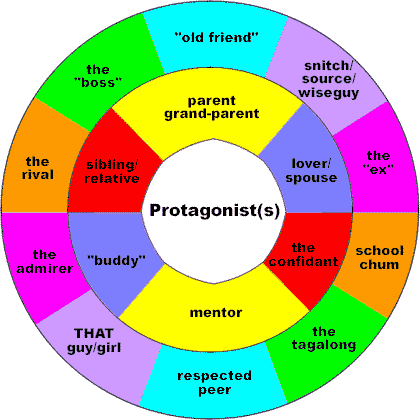 The diagram is done as two circles. The circle most immediate protagonist has the
types that tend to occupy bigger roles both in terms of the story and in the protagonist's life.
The diagram is done as two circles. The circle most immediate protagonist has the
types that tend to occupy bigger roles both in terms of the story and in the protagonist's life.