 |
Beginning Writer's CraftThe Energy of Showing and the Gravity of Exposition© Will Greenway 2000 |
 |
Dark. You don't remember when it became dark. You turn and look up at the laced branches of the oaks that seem to bend over you. The smell of dank earth mingled with the acrid scent of burned wood is
heavy and sharp. The warm air of the clearing has turned cold and wet. It's like being in a cave rather than beneath a canopy of trees. The rustle of branches seems to echo and the sounds of animals is muted.
Is this where the instructor retreats to between sessions? You rub your arms, feeling a twinge in your stomach. It seems more like the resting place of a vampire than anything else. A vampire? Now your imagination was running scared. Such things didn't exist—at least not in the place you came from. Creatures of the undead only live in stories.
Running a hand through your hair, you draw a breath. Your appearance in this strange place and the concern that you and the others share in returning home has all kinds of wild speculations running through your head. Still, what kind of normal person lived in hole like this? A writing teacher...? Please. There must be a rational explanation to everything. It just better not be a dream.
A chime begins ringing in the clearing behind you. The next seminar is starting. Best to leave off exploring for now. Nine seminars are left, so there's still plenty of time to figure out what's going on. You step into the clearing behind the pudgy teacher who's already taken a seat on the tree stump in front of the class. You notice many of the students focus on you with curious expressions.
The teacher stops speaking and turns back to look at you. His blue eyes narrow. He gestures to a spot in the front row. He frowns as you move to take a seat.
"As I was saying," he emphasizes. "This session will be about active narrative and exposition..."
'Show don't tell', you must have heard that phrase if you've spent any length of time writing seriously. It is a simple paradigm and guidance that is all some writers need to produce quality stories. Unfortunately, if you are feeling your way through learning to write, perhaps it's too simple and too open to be a lot of help. After all, what is meant by showing, and further, what's so bad about telling…?
 Let's start with telling. There's nothing wrong with telling. It's simply that
there's nothing good about it. In print, typical journalism tells us the facts every day.
Telling is the presentation of the facts and details without the benefit
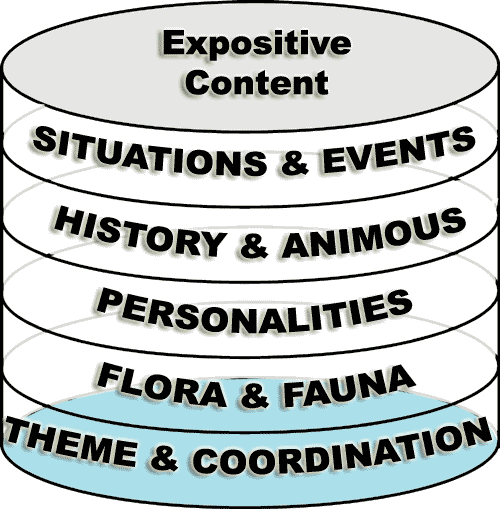
of the feelings and emotions of a viewpoint character. Another word for telling is 'exposition'. Exposition serves an important critical role in story, see the diagram
for some examples of what we generally use exposition to describe.
Let's start with telling. There's nothing wrong with telling. It's simply that
there's nothing good about it. In print, typical journalism tells us the facts every day.
Telling is the presentation of the facts and details without the benefit
of the feelings and emotions of a viewpoint character. Another word for telling is 'exposition'. Exposition serves an important critical role in story, see the diagram
for some examples of what we generally use exposition to describe.
At this point, you might be thinking that you still don't see anything wrong. In fact, exposition seems instead to be a good thing. There's some essential elements in that list of things described by expositive content. You wouldn't be totally wrong.
However there is storytelling, good storytelling, and there is emersive storytelling. It's obvious that they are all talking about the same thing, but what's being indicated is the quality of how the story is related to the reader. Many of the things listed in expositive content are often simply thrown at the reader. In read and critique circles this is often called an 'info dump' or 'reader feeder' and is indicative of when the writer stops the progress of the story to relate details.
Take note—we say the writer 'stops' the story to give us the information. Another way to think of this is the artifice of a narrator in a play. At key sections, the actors stop, and the narrator comes to the front of the stage to explain some important elements the audience needs to know in order to follow the story. While the narrator is explaining, the story (play) is essentially stopped and is not progressing.
This is exactly what happens in your work when a reader comes to a big chunk of exposition in your narrative. The characters stand around tapping their toes, time does not advance in natural progression, and while you may describe things that happen they are not felt or experienced.
If you think of your story as spell cast over the reader, this is indeed a bad thing. The suspension of disbelief pulling them through your world and characters is being set aside so you can grab the reader's ear and give something along the lines of: 'oh by the way... you need to know this... and this... and this...'.
The key thing here is that much of what beginning writers give to us as exposition is either entirely unnecessary, misplaced in the narrative, or could be 'shown' to us by means of indirection.
Here's an example. Say we have a character in the story named Alice. Alice is an extremely beautiful woman who is totally unaware of how her attractiveness affects others.
As the writer you could simply just tell us this. Alice was a beautiful woman lived in a village thus and such. She was so fetching that the men acted foolish and the women were jealous... I could go on, but that's enough to illustrate the point. No matter how fancy I write that description, it is a passive and non-emersive telling. It's not moving nor really all that entertaining. Now consider this instead. We develop a scene where we want to show the affect that Alice has on everyone. Perhaps Alice is not the protagonist in the story, but is instead a friend of the more worldly and tuned in viewpoint character who laments to herself and Alice about how clueless she is. The scene opens in the town tavern with Alice walking in and all the men trying to impress her, and eventually getting into a fight over it. Alice is both moved and confused as to why she has all this attention. Without even giving you this scene, I think you can tell how this will be more involving and is potentially far more entertaining.
Telling does little to develop character. Scenes show character in action. Practically everything that you can do with exposition can be done with clever use of illustrative scenes. The next time you sit down to produce some material and you find yourself typing or writing out a big chunk of text without characters or dialogue in it, stop yourself and evaluate what function that material serves. Is this information essential? In other words, must the reader know it to enjoy the story. If knowing these details is necessary or helpful consider giving a illustrative scene instead that shows us this instead.
The hows of this are often the biggest challenge to new writers when they first start taking this advice to heart. Usually, the first attempts are a static scene where two characters sit and discuss the information. Sometimes the writer simply takes the exposition itself and has one of the characters give the infodump verbatim. If you've done any amount of reading, you will recall scenes like this. Beginners do it, but so do seasoned authors with many published books in their repertoire. For the published authors, it's indicative of someone in a hurry, or simply too lazy to be a little more imaginative. The reason I come down on it is because when these characters spew out all this information it is usually given in a way that is totally out of character. Often they are discussing information that is common knowledge to all the characters in the story. It usually starts out something like, "As you recall...". So, why in the heck do they go ahead and discuss something they already know?
Be assured, I can say with all confidence for every little convoluted detail that might be important to your story there *is* a way to dramatically show it. For many writers the difficulty comes from them being too literal. You must be willing to be abstract in your thinking of the story. It is vital that you see your story as a series of linked scenes that organically lead into one another. If the detail you wish the reader to know is critical, then the natural structure of the story will include or revolve around the demonstration of that important revelation.
 Take
for instance, say a character has a phobia of spiders. How hard is it to
have a scene that demonstrates that? Say the detail is a little more
difficult to reveal, like one character loves another, but for whatever reason
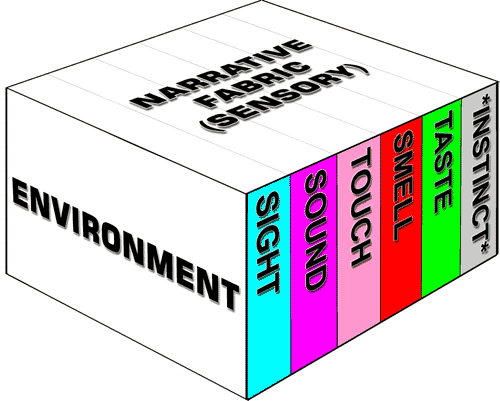
can't show it. This is when point of view and sensory detail become
crucial to your narrative. You can SHOW emotion by describing the physical
registers of a character as the scene progresses. Physical registers are a
mapping of emotions to sensations that we as people feel.
Take
for instance, say a character has a phobia of spiders. How hard is it to
have a scene that demonstrates that? Say the detail is a little more
difficult to reveal, like one character loves another, but for whatever reason
can't show it. This is when point of view and sensory detail become
crucial to your narrative. You can SHOW emotion by describing the physical
registers of a character as the scene progresses. Physical registers are a
mapping of emotions to sensations that we as people feel.
As an example, think of the last time you were angry, not just a little bit mad, but really PISSED OFF. What happened? Didn't your heart pound? Didn't face get hot? Did your hands clench? Did your chest hurt? Did you feel an uncontrollable urge to hurt/injure/destroy the source of your anger? Some people go further, their mouth gets dry and there's a ringing in their ears. Things in their vision start to turn red—yes, you really do see red... it's not just a phrase.
Now here's an illustrative example of expositive telling verses showing with
physical registers:
Expositive
John was really pissed. He wanted to wrap his fingers around the
creep's neck and squeeze until he expired.
Active narrative
John gritted his teeth and clenched his fists. His heart pounded and his face burned. The only thing on
his mind at the moment was wrapping his fingers around that creep's neck and squeezing...
This is the essence of show not tell—I don't say John is pissed, but the body language, the physical registers, and the coordinating context (him wanting to choke the life out of the creep) suggest this without telling.
There is almost always room for this technique for every kind of mood and emotion. It goes hand-in-hand with physical contact between characters and really setting up a relationship between the reader and your characters. The real study is to sit down and think about what physical registers go with what emotions and then separating them out.
Your heart will speed up for a lot of emotions that are related to excitement. You grit your teeth for pain or restrained emotions. Your face gets hot from embarrassment or anger. Your stomach tends to knot or get icy when you feel fear or dread. Your skin will prickle, or your whole body can get cold depending on how strong the emotion is. Sadness may make your throat tighten or constrict.
Hands do a lot of things that describe emotion, usually clenching into fists, tangling in hair, or doing whatever else helps deal with the stress.
Some emotions overlap like anger and passion. When we feel passion towards a person it is similar to anger. Our faces get hot, our hearts beat fast—so the inner monologue that goes with those sensations is key to the reader understanding what the character is experiencing.
This section has introduced you to the difference between telling and showing. Registers are a narrative tool that we mix with a good choice of scene to eliminate flat (expositive) telling and get the reader involved in the story. We'll develop this concept more in the next section as we expand on point-of-view and how it relates to narrative and exposition.